Sydney is in the middle of the largest infrastructure build cycle in its history. Western Sydney International Airport opens in October 2026. Sydney Metro West is under construction with a budget north of $27 billion. The Sydney Metro line to Western Sydney Airport is expected to open in mid-to-late 2027. Bradfield City Centre is being developed as the first new Australian city in over a century.
Behind these headline projects sit thousands of supporting contracts: civil works, electrical installations, plumbing, telecommunications, road construction, earthworks, and utility connections. Every one of those contracts puts vehicles on the road, and those vehicles need bodies that can handle what the work demands.
For fleet managers and trades contractors across Greater Sydney, this infrastructure pipeline is not just about more work. It is about different work, in different conditions, with different requirements for how truck and ute bodies are specced.
More Vehicles, More Pressure on Lead Times
The sheer volume of infrastructure work across Western Sydney is driving demand for trade vehicles. Contractors winning infrastructure subcontracts need to mobilise fleets quickly, which means ordering cab chassis and getting bodies fitted on tight timelines.
When vehicle demand spikes, two bottlenecks appear. Cab chassis supply tightens as dealers allocate stock across more buyers. And body builders get busier, which pushes lead times out.
For a fleet manager who needs four trucks on the road by the time a civil contract starts in six weeks, a body builder quoting eight to ten weeks is not an option. The cost of a vehicle sitting idle while waiting for a body is real. At $800 to $1,200 per day in lost productive capacity, a four-week delay on four trucks can represent a significant loss before the contract even begins.
Contractors who plan fleet builds ahead of contract commencement have a major advantage. Working with a body builder who can commit to delivery dates and hold them is a competitive edge in a market where mobilisation speed wins contracts.
Longer Travel Distances Are Changing the Weight Equation
Infrastructure projects in the South-West Growth Corridor (Camden, Narellan, Gregory Hills, Oran Park) and around the new airport precinct at Badgerys Creek are pulling contractors further from their traditional operating areas.
Longer daily travel distances change the economics of body weight. A heavier body burns more fuel per kilometre. When vehicles are covering 80 to 120 km per day instead of 40 to 60 km, the fuel cost difference between a heavy steel body and a lighter aluminium truck body becomes more pronounced.
Fleet operators working across the infrastructure corridor need to factor total daily travel into their body spec decisions. A 30 per cent weight saving on an aluminium body compounds into meaningful fuel savings when the vehicle is doing twice the daily kilometres it used to.
Multi-Trade Requirements Are Getting More Complex
Large infrastructure projects require vehicles that do more than carry one trade’s tools. A single truck on a utilities installation project might need to carry cable, conduit, junction boxes, hand tools, power tools, testing equipment, PPE, and traffic management gear, all at the same time.
This complexity is pushing body design away from simple open-tray layouts and toward purpose-built enclosed bodies with multiple compartment zones, segregated storage for different material types, and quick-access panels for high-rotation items.
The plumber’s truck that used to carry pipes, fittings, and a few hand tools now needs room for a jetting unit, camera equipment, and confined space entry gear if the crew is working on water infrastructure projects.
The electrician’s truck that handled suburban switchboard work now needs to carry high-voltage testing equipment, cable pulling rigs, and communications hardware for smart grid installations.
These expanding trade requirements mean the body needs to be designed around the specific project scope, not just the trade category. A custom truck body that worked for suburban maintenance may not have the compartment layout, weight distribution, or access points needed for infrastructure-scale work.
Site Access and Security Are Getting Stricter
Major infrastructure sites across Sydney operate under strict access and safety protocols. Vehicles entering these sites need to meet requirements that go beyond normal road registration.
Common site requirements include compliant load restraint systems (chains, straps, or purpose-built racks for all loose items), fire extinguisher mounts in accessible, visible locations, first aid kit storage, high-visibility vehicle markings or livery, and sometimes GPS tracking or fleet management system integration.
Bodies designed for infrastructure work need to accommodate these requirements from the start, not as afterthoughts bolted on later. A fire extinguisher bracket mounted inside a compartment is not the same as one that meets site audit requirements for visibility and accessibility.
For contractors working across multiple infrastructure sites with different principal contractors, the body needs to meet the strictest standard across all sites. Building to the highest common denominator avoids the cost and delay of retrofitting bodies to pass individual site audits.
Dust, Water, and Corrosion Are Worse on Construction Sites
Infrastructure construction sites expose vehicles to conditions that are significantly harder on bodies than normal suburban use.
Dust from earthworks and road construction gets into every gap, seal, and hinge. Concrete dust is particularly abrasive and, when wet, forms a paste that accelerates corrosion on steel components. Standing water from dewatering, stormwater, and wet concrete work coats vehicle undersides and pools around mounting points.
Vehicles working on water infrastructure projects for clients like Sydney Water or utility connections for Endeavour Energy face continuous moisture exposure that destroys unprotected steel within a few years.
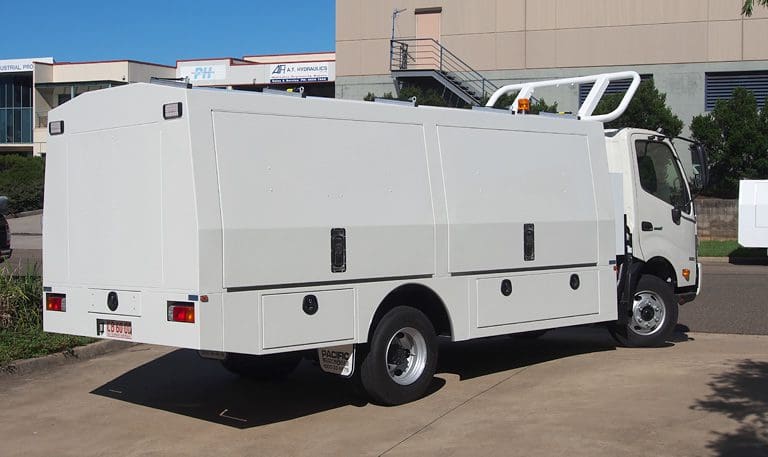
Aluminium bodies have a clear advantage in these conditions. They do not rust, they handle dust abrasion better than painted steel surfaces, and they do not need ongoing corrosion treatment to survive wet and dirty environments. Pacific Bodyworks builds aluminium bodies that are used extensively across Sydney’s infrastructure and utilities sectors, including for organisations like Sydney Water, Endeavour Energy, and TransGrid.
The Aerotropolis Effect: A New Operating Zone
The Western Sydney Aerotropolis, centred on the new airport and Bradfield City Centre, is creating an entirely new operating zone for trades and fleet vehicles. This precinct will generate demand for electrical, plumbing, civil, telecommunications, and mechanical services on a scale that Western Sydney has not seen before.
Contractors positioning to win work in the Aerotropolis need fleets that are ready for the environment: new roads with construction traffic, long distances from established suburbs, limited on-site amenities, and project timelines measured in years rather than weeks.
For body builders, the Aerotropolis represents a shift toward longer-lifecycle bodies designed for sustained project work rather than short-term suburban jobs. Bodies need to be built to handle multiple years of daily use on construction sites without the frequent access to workshops and maintenance facilities that suburban operations enjoy.
What This Means for Your Next Body Order
If your business is targeting infrastructure work across Greater Sydney over the next three to five years, the way you spec your truck bodies should reflect the demands of that work.
Lighter bodies save fuel on the longer daily distances that infrastructure work requires. Enclosed, compartmentalised designs handle the multi-trade, multi-equipment requirements of large project sites. Corrosion-resistant materials survive the dust, water, and concrete exposure of construction environments. Compliance-ready features (load restraint, fire safety, visibility) get your vehicles through site audits without retrofit.
And above all, a body builder who can deliver on time and hold to a production schedule gives you the mobilisation speed that wins subcontracts in a competitive infrastructure market.
Spec Your Fleet for the Infrastructure Pipeline
Pacific Bodyworks builds custom aluminium truck bodies and fleet vehicle solutions for trades and contractors across Greater Sydney. If you are mobilising for infrastructure work and need bodies that match the conditions, contact Steve Mills on 1300 334 878.