
A service body should last as long as the vehicle underneath it. For most trade utes and light trucks, that is five to seven years of hard daily use. Some last ten or more.
But plenty of service bodies start falling apart well before the three year mark. Doors that will not seal. Compartments that rattle loose. Hinges that seize. Weld joints that crack. Rust that spreads from one small chip until entire panels need replacing.
When a body fails early, it is not bad luck. It is almost always the result of specific shortcuts taken during design, material selection, or fabrication. If you know what to look for, you can avoid buying a body that is built to fail.
Shortcut 1: Cheap Materials Dressed Up as Quality
Not all aluminium is the same. And not all steel is the same. The alloy grade, thickness, and temper of the sheet metal used in a service body directly affect how long it will last.
A body builder cutting costs on materials might use a lower grade aluminium alloy that is easier to work with but more prone to fatigue cracking. Or they might use thinner sheet than the design requires, which saves material cost but creates panels that flex, oil-can, and eventually crack at stress points.
With steel bodies, the material shortcuts are even more common. Mild steel is cheap and easy to fabricate, but it rusts fast if the surface protection is not done properly. And some builders use thinner gauge steel than the application needs, relying on paint to hide what the metal cannot support structurally.
The problem is that you cannot see material quality by looking at a finished body. A freshly painted steel body looks the same whether it is made from 3 mm structural steel or 1.6 mm mild steel. The difference only shows up 18 months later when the doors start sagging and the panels start flexing.
Shortcut 2: Poor Weld Quality
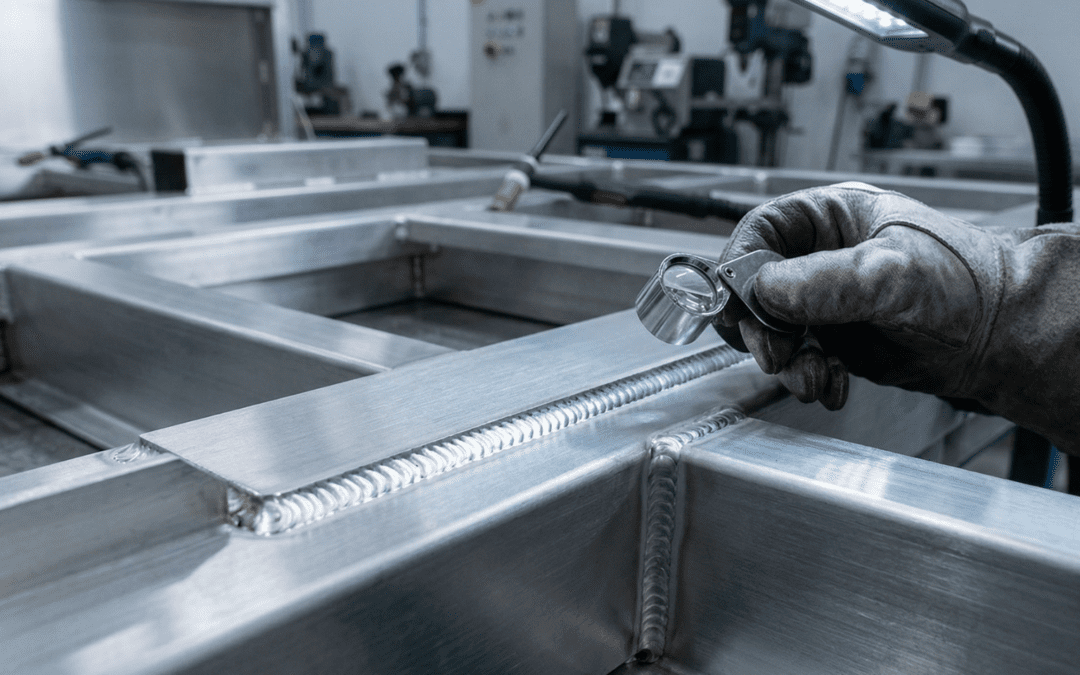
Welding is the backbone of any fabricated service body. Every joint, every bracket mount, every hinge plate, and every structural member is held together by welds. If those welds are not done right, the body will fail.
Common welding shortcuts include incomplete penetration (the weld does not go deep enough into the joint), cold welds (not enough heat to properly fuse the metal), and skip welding (welding intermittently along a joint instead of running a continuous bead where one is needed).
On aluminium bodies, weld quality is even more critical because aluminium welding requires more skill and better equipment than steel welding. A fabricator without proper TIG welding capability and trained aluminium welders will produce joints that look acceptable but fail under vibration and load cycling.
At Pacific Bodyworks, every aluminium service body is welded by qualified aluminium fabricators using TIG welding processes. The welds are structural, not cosmetic. That is a distinction worth understanding when you are comparing quotes.
Shortcut 3: No Weatherproofing Strategy
A service body spends its life outdoors. Rain, humidity, road spray, dust, and temperature swings are constants. If the body is not designed to handle water intrusion, the problems start fast.
The most common failure point is door seals. Cheap rubber or foam seals compress and lose their shape within a year, allowing water into tool compartments. Wet tools rust. Electrical equipment corrodes. Paperwork and materials get damaged. And once water gets inside the body structure itself, it accelerates corrosion from the inside out.
Other weatherproofing failures include unsealed mounting holes (where the body bolts to the chassis), gaps at panel joints that are not properly sealed, and drain paths that block with debris and hold standing water against the body panels.
A properly built body has weatherproof door seals that maintain compression over years of daily use, sealed internal seams that prevent water tracking between panels, and drainage designed to move water away from structural joints.
Shortcut 4: Hardware That Cannot Handle Daily Use
Hinges, latches, locks, and gas struts are the moving parts of a service body. They get opened and closed thousands of times a year. Cheap hardware fails fast.
Common hardware failures include hinge pins that wear and allow doors to sag, latches that lose their catch and let doors rattle open on rough roads, locks that seize or strip after exposure to dust and moisture, and gas struts that lose pressure and let heavy doors drop.
The cost difference between quality hardware and cheap hardware on a full service body might be a few hundred dollars. But replacing failed hardware in the field, including labour, parts, and the downtime while the vehicle is off the road, costs far more than the original saving.
Shortcut 5: Body Design That Ignores Real World Stress
A service body on a trade vehicle lives in a harsh environment. It gets driven over rough roads, loaded and unloaded daily, and subjected to constant vibration. The body design needs to account for these forces.
Common design failures include mounting points that are too few or too weak for the body weight, unsupported spans of panel that flex under load, compartment dividers that are not structurally tied to the main frame, and tailgates or rear doors that are not properly braced against the weight of a full load pushing against them.
Good body design distributes stress across the entire structure rather than concentrating it at a few points. It uses gusseting, bracing, and continuous structural members to create a body that moves with the vehicle instead of fighting against it.
Shortcut 6: Surface Finish That Hides Problems
A fresh coat of paint or powder coat can hide a lot of sins. Rough welds get smoothed over. Panel gaps get filled. Surface imperfections disappear under colour.
There is nothing wrong with a painted body. But if the paint is being used to hide fabrication defects rather than protect a well-built structure, you are buying a body that looks good on delivery day and starts showing its real quality within months.
This is one reason aluminium bodies in a natural mill finish are worth considering. With no paint to hide behind, the quality of the fabrication, welding, and finishing is visible. Every weld joint, every panel fit, and every hardware mount is on display. A builder confident enough to deliver a body in mill finish is a builder confident in their workmanship.
How to Avoid Buying a Body That Fails Early
Before you commit to a body builder, ask these questions:
What alloy grade and sheet thickness do you use? Can you show me examples of your weld quality? What type of door seals do you use and how long do they last? What brand of hinges, latches, and locks do you use? Can I visit your factory and see a body in progress? Do you have bodies that are three or more years old still in service that I can see or get references for?
A good body builder will answer every one of these questions without hesitation. A builder who deflects, changes the subject, or gets defensive about quality questions is telling you something important.
What 35 Years of Builds Tells You
Pacific Bodyworks has been fabricating durable aluminium service bodies in Sydney since 2003, and our Managing Director Steve Mills has over 35 years of industry experience. We build bodies for fleets that include Sydney Water, Endeavour Energy, TransGrid, and Sydney Trains.
Those clients do not tolerate bodies that fail early. They run compliance audits, track maintenance costs, and hold their suppliers accountable for build quality over the full vehicle lifecycle. That level of accountability shapes how we build every body, whether it is for a major utility or a single ute for an independent tradesman.
If you want a service body that is still performing at year five, not falling apart at year three, contact Steve on 1300 334 878 and come see how we build.