
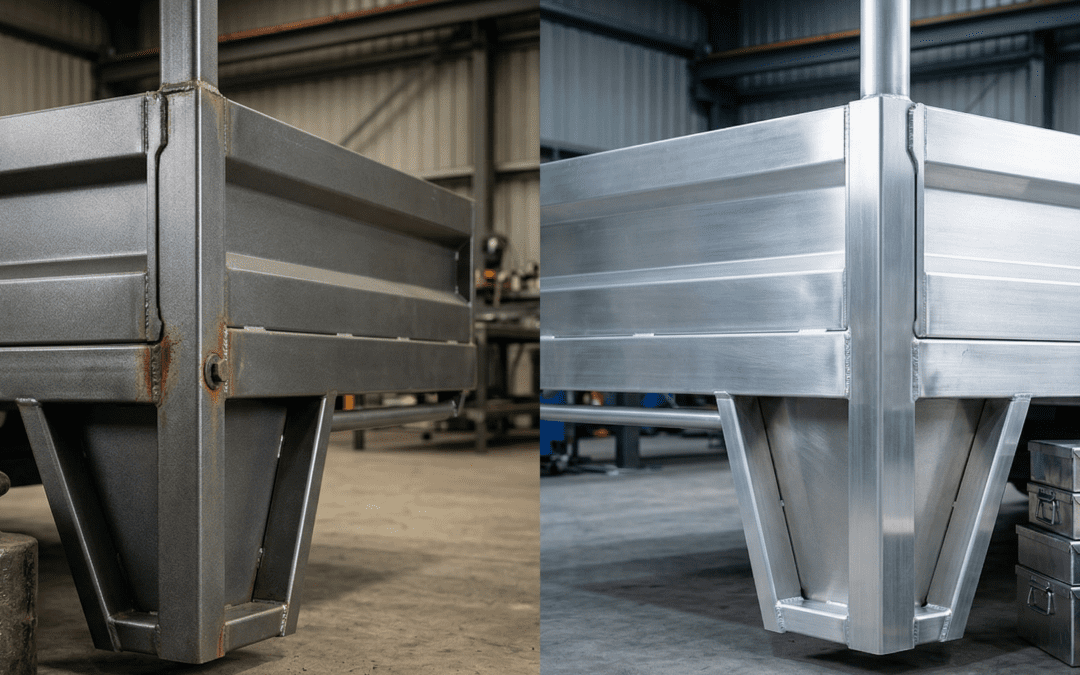
If you run a fleet of trade vehicles in Sydney, the material your service body is made from affects everything. It changes how much gear your crew can carry. It changes how much you spend on fuel. It changes how long the body lasts before it needs replacing.
Most fleet managers eventually face this choice: aluminium or steel? Both materials work. Both have trade-offs. But once you look at the numbers side by side, the gap between them is hard to ignore.
This is a straight comparison across weight, cost, payload, fuel economy, corrosion resistance, and total lifespan. No spin. Just what each material actually delivers on a working vehicle.
Weight: Where the Gap Starts
Aluminium is roughly one third the density of steel. In practical terms, an aluminium service body built for a dual cab ute will typically weigh around 30 per cent less than an equivalent steel body with the same dimensions and compartment layout.
That weight difference is not a small thing. On a vehicle with a Gross Vehicle Mass (GVM) limit set by the manufacturer, every kilogram the body weighs is a kilogram your crew cannot carry in tools, materials, or equipment.
For a plumber carrying a jetting unit, or an electrician with cable drums and conduit, that 30 per cent weight saving can mean the difference between staying legal and running overloaded.
Payload: The Number That Pays Your Bills
Here is where the weight gap turns into money.
Take a common dual cab ute with a GVM of 3,200 kg. With the cab, chassis, driver, fuel, and a steel service body fitted, the remaining payload for tools and materials might sit around 500 to 600 kg.
Swap that steel body for an aluminium one and you could pick up an extra 80 to 150 kg of usable payload, depending on the body size and configuration.
That extra capacity is not just about carrying more. It is about staying compliant. Overloaded vehicles attract fines, void insurance, and put your drivers at risk. A lighter body gives you a bigger safety margin before you hit the limit.
For fleet operators managing eight to fifteen vehicles, multiply that payload gain across the entire fleet and the operational advantage adds up fast.
Fuel Economy: The Running Cost Most People Underestimate
A lighter vehicle uses less fuel. The relationship is not perfectly linear, but as a general rule, reducing vehicle weight by 10 per cent can improve fuel consumption by around 5 to 7 per cent in stop-start urban driving.
For a trade vehicle doing 30,000 to 40,000 km per year across Greater Sydney, that fuel saving can add up to hundreds of dollars per vehicle annually. Across a fleet, it becomes a meaningful line item.
Steel bodies are heavier, which means the engine works harder on every acceleration, every hill climb, and every stop-start cycle through suburban job sites. Over a five year body lifespan, the cumulative fuel cost difference between aluminium and steel is worth calculating before you commit.
Corrosion Resistance: Sydney’s Hidden Cost
Sydney’s climate is tough on steel. Coastal salt air reaches well into Western Sydney on the right wind. Vehicles working around water infrastructure, near the coast, or in wet conditions face constant moisture exposure.
Steel service bodies need ongoing surface treatment to resist rust. Once the paint or powder coat chips, corrosion starts and spreads quickly around door seals, hinges, and weld joints. Left unchecked, rust weakens the structure and creates sharp edges that are a safety hazard on site.
Aluminium does not rust. It forms a natural oxide layer that protects the surface without any additional coating. You can run an aluminium ute body in a raw mill finish with no paint at all and it will still resist corrosion for decades.
For vehicles working near Sydney Water infrastructure, TransGrid substations, or coastal job sites, this is not a minor advantage. It is a major factor in long term body condition and resale value.
Upfront Cost vs Total Cost of Ownership
Steel service bodies are cheaper to buy upfront. That is true. The raw material costs less, and the fabrication process for steel is generally faster.
But upfront price is only part of the equation. Total cost of ownership over a five to seven year body lifespan includes fuel, maintenance, repairs, repainting, corrosion treatment, and eventual replacement.
When you factor in fuel savings from reduced weight, lower maintenance from corrosion resistance, fewer repairs from material fatigue, and longer usable lifespan, aluminium bodies often cost less over the full ownership period.
The breakeven point depends on how many kilometres the vehicle covers, the conditions it works in, and how long you keep the body. For high-mileage fleet vehicles in Sydney, aluminium typically pays for itself within the first two to three years of operation.
Strength and Durability: Busting the “Aluminium Is Soft” Myth
One of the most common objections to aluminium is that it is “too soft” for heavy trade use. This comes from comparing raw aluminium sheet to raw steel sheet, which is not how service bodies are built.
Modern aluminium service bodies use marine-grade alloys (typically 5083 or similar) that are specifically chosen for their strength to weight ratio. The body design uses structural bracing, folded panels, and welded joints that create rigidity without excess weight.
A well-built aluminium service body will handle the same daily abuse as a steel one. The difference is that it does it at 30 per cent less weight, without rusting, and with better long-term fatigue resistance in the weld zones.
Pacific Bodyworks has been building durable aluminium service bodies for trades and fleet operators across Sydney since 2003. The bodies we built in our early years are still on the road, which says more about the material’s durability than any spec sheet can.
Repairability: What Happens When Things Go Wrong
Both materials can be repaired after damage. Steel is easier to weld with basic equipment, which means more workshops can handle small repairs. Aluminium welding requires TIG or MIG with argon shielding, which is more specialised.
However, aluminium is easier to reshape after minor dents and impacts because it is more malleable. And because it does not rust, a repair does not need to be followed up with primer, paint, and rust treatment the way a steel repair does.
For fleet managers, the key question is not which material is easier to repair. It is which material needs repairing less often. Aluminium’s corrosion resistance and fatigue properties mean fewer repairs over the body’s life.
Which Material Wins?
There is no single answer that fits every situation. Steel still makes sense for some heavy-duty applications where maximum rigidity matters more than weight savings.
But for trade and fleet service bodies on utes and light trucks, aluminium wins on nearly every metric that affects your operating costs: weight, payload, fuel, corrosion, lifespan, and total cost of ownership.
If you are speccing new service bodies for your fleet, it is worth running the numbers for your specific vehicles and use case. The upfront price difference shrinks fast once you factor in what each material actually costs to live with over five to seven years.
Get a Quote on Aluminium Service Bodies
Pacific Bodyworks builds custom aluminium service bodies for trades and fleets across Greater Sydney. If you want to talk through specs, payload calculations, or get a quote for your next vehicle, contact Steve Mills on 1300 334 878.