
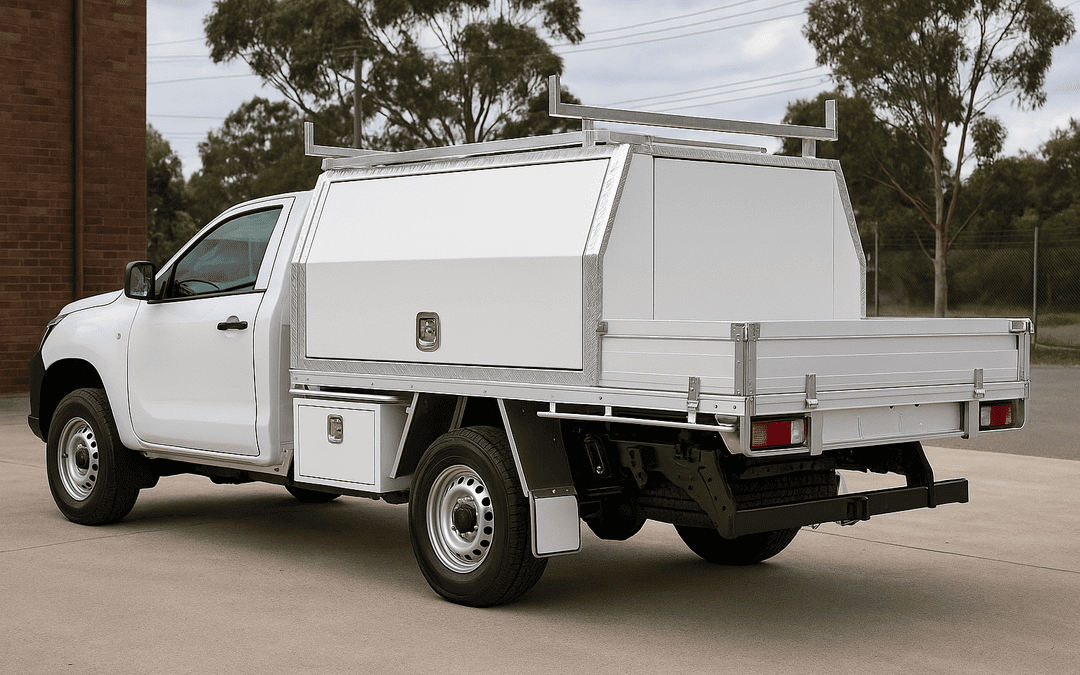
When fleet managers start budgeting for a custom truck body, they almost always focus on one number: the quoted price from the body builder. That quote covers the fabrication, materials, and basic fitout. What it rarely captures is everything else that goes into getting a custom body on the road and keeping it there.
The true cost of a custom truck body includes the chassis prep, the fitout components, the finishing, the compliance work, the downtime during the build, and the ongoing maintenance across the body’s working life. When you add all of that up, the gap between a cheap quote and a quality build gets much smaller than it looks on paper.
This is a breakdown of what actually goes into the cost of a custom truck body in Sydney in 2026.
Cost Component 1: Materials
The material cost is the foundation of every build quote. For a custom aluminium truck body on a light truck chassis (Isuzu NPR, Hino 300, Fuso Canter, or similar), the aluminium sheet, extrusion, and structural components make up a significant portion of the total cost.
The price of aluminium fluctuates with global commodity markets, and in recent years, those fluctuations have been sharp. The alloy grade matters too. A body built from marine-grade 5083 aluminium costs more in raw materials than one built from a lower-grade alloy, but it also lasts longer and handles corrosive environments better.
Steel truck bodies use less expensive raw material, but the steel itself is heavier and requires surface treatment (primer, paint, or powder coat) that adds back some of the material cost saving. The net material cost difference between aluminium and steel is smaller than most people assume once finishing is factored in.
For fleet operators comparing quotes, ask what alloy grade the builder uses and what sheet thickness. A quote based on thinner material or a lower-grade alloy will be cheaper upfront but may cost more in repairs and early replacement.
Cost Component 2: Design and Engineering
A truly custom truck body is not pulled from a template. It starts with a design conversation: what trade, what equipment, what vehicle, what payload target, what access requirements.
Some body builders include basic design work in their build price. Others charge separately for detailed CAD drawings, structural calculations, or compliance engineering. For a straightforward build on a common chassis, design costs are minimal. For a complex, trade-specific body (a jetter truck, a hydraulic hose repair rig, a mobile workshop), the design phase can take days and involves real engineering work.
At Pacific Bodyworks, the design process is built into every truck body project. Our team works with the client to get the layout right before fabrication starts, which avoids costly mid-build changes. For complex builds like the Ginardi custom truck body in Marrickville, the specs included rear central storage for bulky items, top entry compartments, under-cab drawers, bifold doors with adjustable shelving, and roof racks. That level of customisation requires upfront design time, but it means the finished body works exactly as intended from day one.
Cost Component 3: Fabrication Labour
Labour is the largest cost component in most custom truck body builds. Cutting, folding, welding, fitting, and finishing a body takes skilled tradespeople working with specialised equipment.
Aluminium fabrication requires TIG welding, which is slower and more skill-intensive than standard MIG welding used on steel. A qualified aluminium welder commands higher rates than a general steel fabricator. That labour cost is reflected in the quote, and it is one of the main reasons aluminium bodies cost more upfront than steel.
The complexity of the build also drives labour costs. A basic flat-deck truck body with side rails takes far fewer hours than a fully enclosed service-style truck body with multiple compartments, doors, drawers, shelving, and integrated lighting. Every additional feature adds fabrication time.
When comparing quotes, ask for a breakdown that separates materials from labour. If a quote is significantly cheaper than competitors, it is worth asking where the savings come from. Lower labour cost usually means fewer hours, which usually means less detail in the fabrication.
Cost Component 4: Fitout and Accessories
The base body structure is only part of the build. Most custom truck bodies get fitted with accessories that add functionality and cost:
Internal shelving and racking systems are sized and positioned to suit the specific tools and equipment the vehicle carries. Trundle drawers (pull-out drawers mounted under the body or in the floor) provide access to heavy items without climbing into the tray. Roof racks and ladder racks are built to match the body dimensions and load requirements. Lighting (LED work lights, compartment lights, warning lights) needs wiring, switching, and weather sealing. Locking systems (slam locks, T-handle locks, central locking) protect tools and materials. Tow bars, jockey wheels, and trailer connections are common additions for fleet vehicles. Water tanks, pump mounts, and hose reel brackets are trade-specific items for plumbing and civil vehicles.
The accessory cost can add 20 to 40 per cent on top of the base body price, depending on how many items are fitted. For a fully kitted fleet truck body, the accessories might cost as much as the body structure itself.
Cost Component 5: Surface Finishing
Surface finishing covers everything from the base protective treatment to full corporate livery.
An aluminium body can be left in a natural mill finish with no paint. This is the lowest cost option and works well for operations that prioritise function over appearance. The aluminium’s natural oxide layer provides corrosion protection without any coating.
For fleet vehicles that need to match corporate colours, painting adds cost. A two-pac enamel finish (the standard for commercial vehicles) requires surface preparation, primer, colour coat, and clear coat. The quality of the prep work matters as much as the paint itself. A well-prepped and painted body will hold its finish for years. A poorly prepped body will start peeling and chipping within months.
Vinyl wrapping and signage are usually handled by a separate supplier after the body is built and painted. These costs sit outside the body builder’s quote but are part of the total vehicle build budget.
Cost Component 6: Compliance and Certification
Every commercial vehicle body fitted in Australia needs to meet regulatory requirements. Depending on the vehicle type and body configuration, this can include:
An engineering sign-off confirming the body meets structural and weight requirements. A modification plate (also called a compliance plate or mod plate) issued by a licensed certifier. Load restraint compliance for items carried on or in the body. Lighting and electrical compliance for any wiring added during the fitout.
Some body builders handle compliance as part of the build. Others leave it to the client, which means finding and paying a separate engineer or certifier. This can add time and cost if it is not planned from the start.
For fleet operators placing multi-unit orders, getting compliance sorted as part of the build contract saves time and avoids delays at registration.
Cost Component 7: Downtime During the Build
This is the cost nobody puts on the quote, but every fleet manager feels it. While the body is being built, the cab chassis is sitting in the builder’s yard not earning revenue.
Build times vary. A standard body on a common chassis might take two to four weeks. A complex custom build can take six to eight weeks or longer, depending on design complexity, material availability, and the builder’s production schedule.
For a fleet vehicle that generates revenue on the road, every week of build time costs the business in lost productivity. If the vehicle would normally generate $800 to $1,200 per day in productive work, a four-week build represents a significant opportunity cost.
Builders who can commit to and hold delivery dates give fleet managers the ability to plan vehicle transitions and minimise downtime. Late delivery is not just an inconvenience; it is a direct cost.
Cost Component 8: Ongoing Maintenance and Repairs
The purchase price is a one-time cost. Maintenance and repairs recur for the entire working life of the body.
Steel bodies require regular inspection for rust, repainting of damaged areas, and replacement of corroded hardware. A steel body in a corrosive environment (coastal, water infrastructure, mining) might need significant rust remediation within three to five years.
Aluminium bodies require less ongoing maintenance because they do not rust. The main maintenance items are hardware replacement (hinges, locks, struts), seal replacement, and repair of impact damage. Over a five to seven year body life, the reduced maintenance cost of aluminium can partially or fully offset its higher purchase price.
Door seals, gas struts, and locking mechanisms are wear items on any body. A builder who uses quality hardware from the start reduces the frequency and cost of these replacements.
How to Compare Quotes Properly
When you receive quotes from different body builders, the cheapest number is almost never the cheapest option. To compare properly:
Make sure every quote covers the same scope: same body dimensions, same accessories, same finish, same compliance. Ask what is included and what is excluded. A quote that excludes shelving, locking, lighting, or compliance is not comparable to one that includes them. Ask about lead time and whether the quoted delivery date is guaranteed or estimated. Ask about warranty coverage: what is covered, for how long, and what is excluded. Ask for references from clients running similar vehicles in similar conditions.
A well-specced quote from a quality builder might look more expensive on the first line, but when you add up everything the cheaper quote excludes, the gap closes fast.
Get an Accurate Quote for Your Build
Pacific Bodyworks builds custom aluminium truck bodies for trades and fleets across Greater Sydney. If you want a detailed quote that covers every cost component with no surprises, contact Steve Mills on 1300 334 878.