
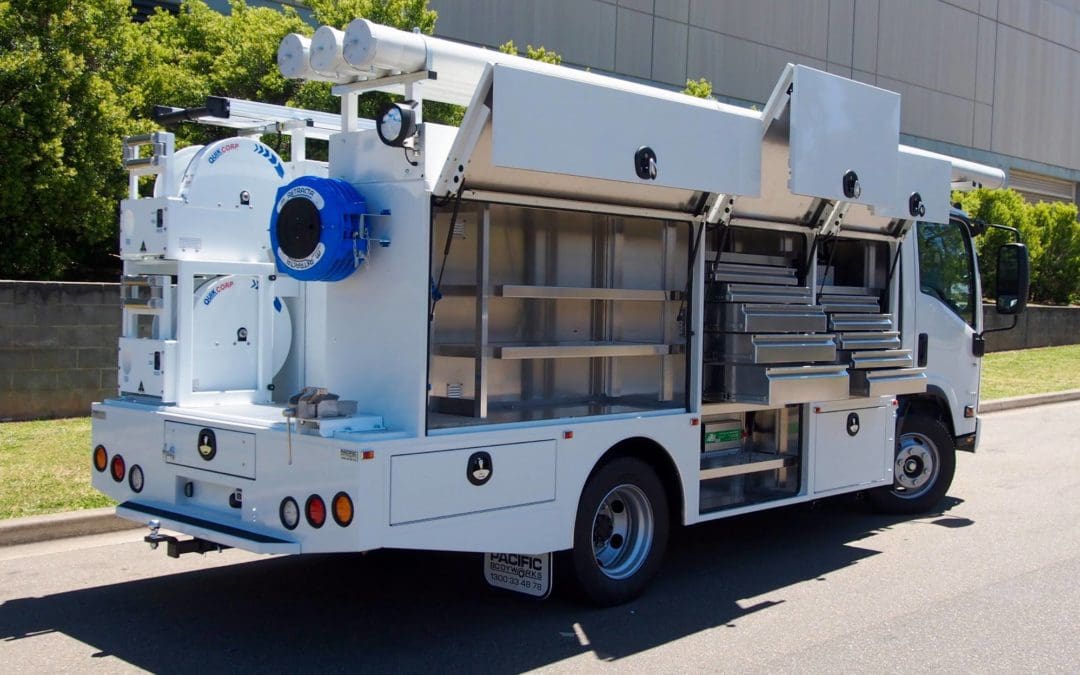
The best service body setup for an Australian plumbing fleet is an aluminium body specced around three constraints, in order: the 4.5 tonne GVM licence threshold, the wet weight of your jetter and water tank, and the longest pipe you carry. Get those three right and everything else is layout. Get them wrong and you end up with a body that either can’t legally carry a full load or needs a licence class half your team doesn’t hold.
Most plumbing fleets buy their bodies one vehicle at a time, and it shows. Three utes turn up to the yard with three different drawer layouts, and every new apprentice has to relearn where the fittings live. The fleets that get this right treat the first build as a specification exercise, not a purchase.
Start with the licence threshold, not the body
The single most expensive mistake in fleet vehicle specification is building past 4.5 tonnes without meaning to. In NSW, a standard class C car licence covers vehicles up to 4.5 tonne GVM. Above that, your driver needs a light rigid licence, and suddenly the pool of people who can take that vehicle out shrinks to whoever bothered to upgrade.
| Licence class | GVM range | What it means for your fleet |
|---|---|---|
| C (car) | Up to 4,500kg | Anyone on staff can drive it |
| LR (light rigid) | 4,500kg to 8,000kg | Requires a licence upgrade before they can drive it |
| MR (medium rigid) | Over 8,000kg, 2 axles | Specialist drivers, smaller hiring pool |
This matters more on a plumbing build than almost any other trade, because water and equipment consume payload faster than tools alone ever will. A fleet that specs to 4,500kg and stays there keeps every vehicle drivable by every employee, which is worth real money in rostering flexibility across a five or ten vehicle fleet.
Match the platform to the work, not the brochure
Plumbing covers a wide span of work, and the right platform changes with it. A maintenance plumber doing six domestic call-outs a day has almost nothing in common, vehicle-wise, with a drainage crew running a jetter.
| Work type | Platform | What drives the spec |
|---|---|---|
| Domestic maintenance and service | Dual cab ute, service body | Fast access, compact footprint, kerbside parking |
| Gas fitting and hot water | Single or extra cab ute, service body | Cylinder restraint, ventilated storage |
| Drain clearing and jetting | Cab chassis truck, custom body | Jetter housing, water tank, hose management |
| Commercial and new build | Cab chassis truck, custom body | Long pipe capacity, bulk material, crew of two or more |
| Emergency and after-hours | Dual cab ute, service body | Lighting, secure storage, everything in one vehicle |
The common error is buying a truck for work a well-specced ute would handle, then paying for the extra licence class, the extra fuel and the parking difficulty for years.
Work out your payload before you design the body
Water is the variable that catches people out. It weighs one kilogram per litre, it counts toward GVM whether the vehicle is moving or parked, and unlike tools it doesn’t get lighter as the day goes on unless you use it. A full 400 litre tank is 400kg of your budget before the tank and mounting hardware.
Everything else you need to weigh rather than estimate, because it varies enormously between manufacturers and models. The calculation is straightforward:
| Step | Where the number comes from |
|---|---|
| Start with GVM | Vehicle compliance plate |
| Subtract tare weight | Compliance plate, or weigh the vehicle at a public weighbridge |
| Subtract crew weight | Your own staff, counted at 85kg each |
| Subtract water | 1kg per litre of tank capacity |
| Subtract jetter or pump unit | Manufacturer’s spec sheet, dry weight |
| What remains | Your budget for the body, tools and materials |
Run this before the body is designed, not after. If the remainder won’t cover an aluminium body plus a realistic tool load, the answer is a smaller tank or a bigger chassis, and both of those decisions are cheap now and expensive later.
One thing to plan for: tool load creeps. Every fleet vehicle gains weight across its service life as fittings accumulate in drawers nobody empties. Specifying to 100 percent of available payload on day one means you’re overweight by year two. Leave headroom.
Jetter and drain fitouts
A jetter needs to be secured, accessible and out of the weather, and it needs to not dictate the entire body layout. The approach that works is housing the unit behind dedicated doors on one side, leaving the opposite side free for conventional tool storage.
Pacific Bodyworks built exactly this for Deep Blue Plumbing, a plumbing and gas fitting company in Sydney’s south west. The jetter sits behind two bi-fold doors on the passenger side, stored neatly inside the body rather than strapped to a tray. The driver’s side carries three bi-fold doors opening onto shelving for tools, so the two functions never compete for the same access point. Under-cab drawers pick up the smaller items, and an extra-long rear pull-out trundle drawer handles the awkward lengths.
Bi-fold doors matter more than they sound. On a narrow suburban street or a tight commercial car park, a gas-lift door that swings up and out needs clearance you often don’t have. Bi-folds open in roughly half the arc.
Pipe and long-material storage
This is where plumbing bodies differ most from other trades. Electricians need conduit capacity, but plumbers routinely carry six metre lengths of PVC and copper, and nothing inside a body will take that.
Roof-mounted racks are the standard answer, and the Deep Blue Plumbing build uses them for exactly this. The spec points that matter are load rating, the height of the rack above the cab roof for the crew loading it, and whether the rack runs the full body length or stops at the cab.
For shorter material, the extra-long rear trundle drawer is the piece most fleets under-specify. It runs the full depth of the body, pulls out at working height, and takes the two and three metre lengths that otherwise get thrown loose on top of everything else.
Tool storage built for five years, not one
The failure mode in service body storage is almost always the same: drawer slides that were never rated for the load, in an environment that is wet, dusty and vibrating for eight hours a day.
The pattern that holds up is a combination of fixed and adjustable storage. Pacific Bodyworks’ build for Ryco, the hydraulic hose service specialist, is a useful reference here even though it is an adjacent trade. It runs three under-cab drawers on both the driver’s and passenger’s sides, two large gas-lift doors on each side revealing adjustable shelving with pull-out drawers behind, and a rear-opening gas-lift door for bulk access. The adjustable shelving is the detail worth stealing. What a plumbing fleet stores in year one is not what it stores in year four, and shelving that can be reset without cutting metal extends the useful life of the body considerably.
An aluminium service body rather than steel returns weight to your payload budget, and on a wet plumbing build that headroom is often what decides between a full tank and a half one. Ask your body builder for the finished weight of the specific body they’re quoting, so it goes into the calculation above as a real number rather than an assumption.
Aluminium is also the sensible material choice for a fleet that will hold vehicles beyond the warranty period. It doesn’t rust when the water tank inevitably weeps, and it holds value when the body is transferred to a new chassis at the end of the vehicle’s life. That transferability is a genuine fleet economic: a well-built aluminium body will outlast the chassis it was first fitted to.
Single or dual cab for two-person crews
The trade-off is direct. A dual cab seats the crew but costs you body length on the same wheelbase. A single cab gives that length back but leaves the offsider in a second vehicle.
For fleets running two-person crews, the question is really whether the second person is a constant or a variable. If a job needs two hands only occasionally, two single cab utes give you more coverage and more body length than one dual cab. If the crew is fixed, the dual cab wins on fuel, insurance and yard space, and you accept the shorter body.
Extra cab or space cab configurations sit between the two, adding secure interior storage behind the seats without the full dual cab length penalty. For a plumbing fleet, that space usually ends up holding the things you don’t want in a locked exterior compartment: paperwork, laptops, wet weather gear.
Spec once, repeat across the fleet
The real return on a custom body arrives on the second vehicle, not the first.
Once a layout is proven in the field, the drawings exist, and every subsequent build is a repeat rather than a new design. That gives you identical vehicles, which means a plumber can move between fleet vehicles without relearning the layout, stock levels become countable across the fleet, and replacement parts are common.
It is worth running the first build as a deliberate prototype. Put it into service for three months, then sit down with the plumber who drove it and change the layout before you order the next four. The changes are almost always small and almost always obvious in hindsight: a drawer that should have been deeper, a door that opens the wrong way for kerbside work, a shelf at the wrong height.
Pacific Bodyworks builds aluminium service bodies, truck bodies and canopies from Wetherill Park in Sydney, for fleets including Sydney Water, Sydney Trains and Endeavour Energy. If you’re specifying a plumbing fleet build, talk to Steve on 1300 334 878 or see our plumbing truck bodies.
Frequently asked questions
What size service body do I need for a plumbing ute?
For a dual cab ute, a body of roughly 1,650mm to 1,800mm length is standard, matching the available chassis space behind the cab. A single cab typically takes 2,400mm to 2,700mm. The length is set by your cab configuration, not by choice, so decide the cab type first.
Can my staff drive a plumbing service truck on a car licence?
Yes, provided the vehicle stays at or under 4,500kg GVM fully loaded. Above that they need a light rigid licence. Because water and equipment can consume a large share of your payload, this needs to be calculated at the specification stage rather than assumed.
Should a plumbing fleet body be aluminium or steel?
Aluminium for almost all fleet applications. It’s lighter, which returns payload on a build where water and equipment consume most of it, it doesn’t corrode in a constantly wet environment, and it can be transferred to a new chassis at the end of the vehicle’s life. Steel is cheaper up front and heavier for the entire service life. Ask for the finished weight of the specific body being quoted so you can compare properly.
How much payload does a water tank use?
One kilogram per litre. A full 400 litre tank is 400kg of your payload budget before the tank and mounting hardware, and it counts toward GVM whether the vehicle is moving or parked.
Can a jetter be stored inside the service body?
Yes. Housing the jetter behind dedicated doors on one side of the body keeps it secure and out of the weather, and leaves the opposite side free for conventional tool storage. This is how the Deep Blue Plumbing jetter truck was configured.
Can I build one vehicle and repeat it across the fleet?
Yes, and it’s the recommended approach. Once a layout is proven in service, the design is repeatable across every subsequent vehicle, giving identical fitouts across the fleet and common replacement parts.