
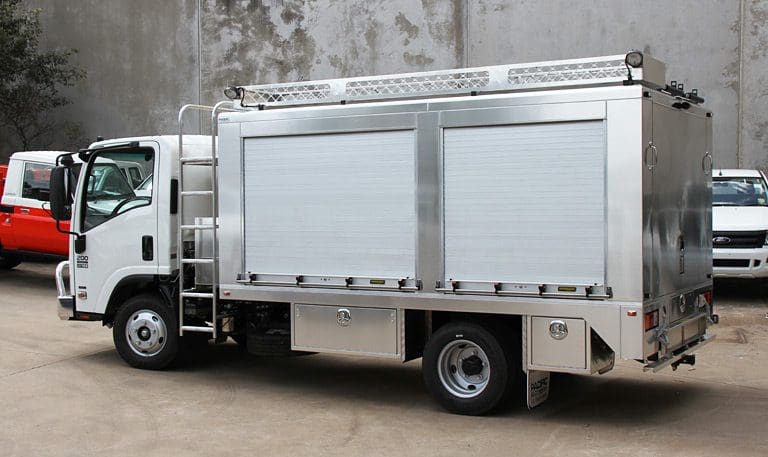
There is a natural instinct when speccing a truck body to go heavier. Thicker panels. Bigger hinges. Beefier subframe. The reasoning sounds solid: build it tougher and it will last longer.
But in practice, over-speccing a truck body creates problems that cost more over the vehicle’s life than the “toughness” saves. Extra weight cuts into payload. Extra material drives up the purchase price. And a body built heavier than it needs to be burns more fuel every single day it is on the road.
The question is not whether you should build tough or build light. The question is how to match the body spec to what the vehicle actually does. Getting that match wrong in either direction costs money.
What “Heavy Duty” Actually Means
The term “heavy duty” gets thrown around loosely in the truck body industry. Different builders mean different things by it, and that inconsistency makes it hard for fleet managers to compare like for like.
In most cases, a heavy duty truck body means thicker sheet metal (often 3 mm or thicker aluminium, or 3 to 5 mm steel), heavier gauge structural members, reinforced mounting points, and larger hardware throughout. The body is designed to handle higher sustained loads, rougher conditions, and more physical abuse than a standard build.
A standard truck body uses lighter gauge materials (typically 2 to 2.5 mm aluminium) with structural bracing designed for normal commercial use. It handles the daily demands of urban trade work without carrying unnecessary weight.
Both specs can be built well. Both can last. The difference is in what conditions they are built for.
The Weight Penalty of Going Too Heavy
Every kilogram of extra body weight is a kilogram you cannot carry in tools, equipment, or materials. On a light truck with a Gross Vehicle Mass (GVM) of 4,500 kg, the difference between a standard aluminium body and a heavy duty one could be 80 to 150 kg.
For a plumbing contractor carrying a jetting unit, pump, hoses, and fittings, that 80 to 150 kg is not abstract. It is the difference between fitting everything on one truck or needing a second vehicle to carry the overflow.
For an electrical contractor running cable drums and conduit, it could mean one fewer drum per vehicle per trip. Over a week of jobs across Western Sydney, that adds up to extra return trips, extra fuel, and extra hours.
The instinct to build heavy “just in case” can actually reduce the vehicle’s operational capacity every day it is on the road. A custom truck body built to the right spec for the actual application will carry more and cost less to run than one built to a spec the vehicle never needs.
The Fuel Cost Nobody Calculates
A heavier vehicle uses more fuel. This is basic physics. The engine has to work harder to accelerate a heavier mass, maintain speed uphill, and brake more frequently in stop-start traffic.
For a light truck doing 25,000 to 35,000 km per year across Sydney, the fuel difference between a standard body and a heavy duty body might be small on a per-trip basis. But multiplied across a full year, and then across a five to seven year body lifecycle, it becomes a real number.
Fleet operators running ten or more trucks should model the fuel cost difference before committing to a heavy duty spec. If the vehicle spends most of its life on suburban streets and sealed roads, the extra fuel cost of a heavier body is pure waste. That money would be better spent on quality hardware, better compartment design, or trade-specific fitout features that actually improve daily productivity.
When Heavy Duty Is the Right Call
There are legitimate applications where a heavy duty body spec is justified and worth the weight penalty.
Mining and resource site vehicles operate on unsealed roads with corrugation, washouts, and constant vibration. The body takes sustained punishment that a standard spec cannot handle over multiple years. A heavy duty build with reinforced mounting, thicker floor panels, and strengthened compartment rails makes sense here.
Vehicles carrying concentrated point loads (crane bodies, compressor mounts, large generators) need structural reinforcement at the load points. A standard body floor and subframe may flex or fatigue under repeated high-load cycles if the body is not designed for the specific equipment.
Emergency services vehicles (fire, rescue, SES) need bodies built to withstand operational forces that go well beyond normal trade use. Rapid deployment, rough terrain access, and heavy rescue equipment demand a body that prioritises structural integrity over weight optimisation.
For these applications, the extra weight and cost of a heavy duty build is a sound investment. The body will be subjected to forces that justify the heavier spec.
When Standard Spec Is All You Need
Most trade and fleet vehicles in Sydney do not need a heavy duty body. If the vehicle operates primarily on sealed roads, services suburban and commercial sites, and carries standard trade tools and materials, a well-designed standard aluminium body will handle the workload.
The key word is “well-designed.” A standard spec body built with marine-grade aluminium, proper structural bracing, quality welds, and good hardware will last five to seven years or more in normal commercial service. It does not need to be built like it is going to a mine site if it is going to Penrith.
Pacific Bodyworks builds aluminium truck bodies for both standard commercial and heavy duty applications. The spec for each build is matched to the actual operating conditions, not defaulted to the heaviest option “just in case.”
The Over-Spec Trap in Fleet Purchasing
Fleet managers sometimes over-spec bodies because of a bad experience with a previous builder. If a cheap, under-built body failed early, the natural reaction is to go to the opposite extreme and demand the heaviest possible replacement.
But the problem with the failed body was not that it was “standard” spec. It was that it was poorly built, used inferior materials, or was designed without understanding the application. The fix for a bad body is a better body, not a heavier one.
Going from a poorly built standard body to a well-built standard body will deliver more durability, longer life, and better daily performance than going from a poorly built standard body to an over-specced heavy duty one.
The right conversation to have with your body builder is not “build it as heavy as possible.” It is “build it right for what it actually does.” That means discussing the operating environment, the loads carried, the road conditions, the daily cycle, and the expected body lifespan.
How to Spec the Right Level
Before committing to a heavy duty or standard spec, work through these questions with your body builder:
What roads and terrain will the vehicle work on daily? Is it mostly sealed suburban, mixed regional, or unsealed mine site? What is the heaviest single item the body will carry, and how often? What is the total daily tool and material weight? Does the vehicle sit in traffic and do stop-start urban work, or does it run highway kilometres between sites? What GVM headroom do you need after the body, driver, and daily load are accounted for? What is the expected body lifecycle: three years, five years, seven years or more?
A body builder who asks these questions before quoting is designing for your operation. One who quotes heavy duty as default is selling you weight you may not need.
Build Right, Not Just Heavy
Pacific Bodyworks has been building custom truck bodies for Sydney trades and fleets for over 35 years. We match the body spec to the application because over-building costs money and under-building costs more. If you want to talk through the right spec for your vehicles, contact Steve Mills on 1300 334 878.