
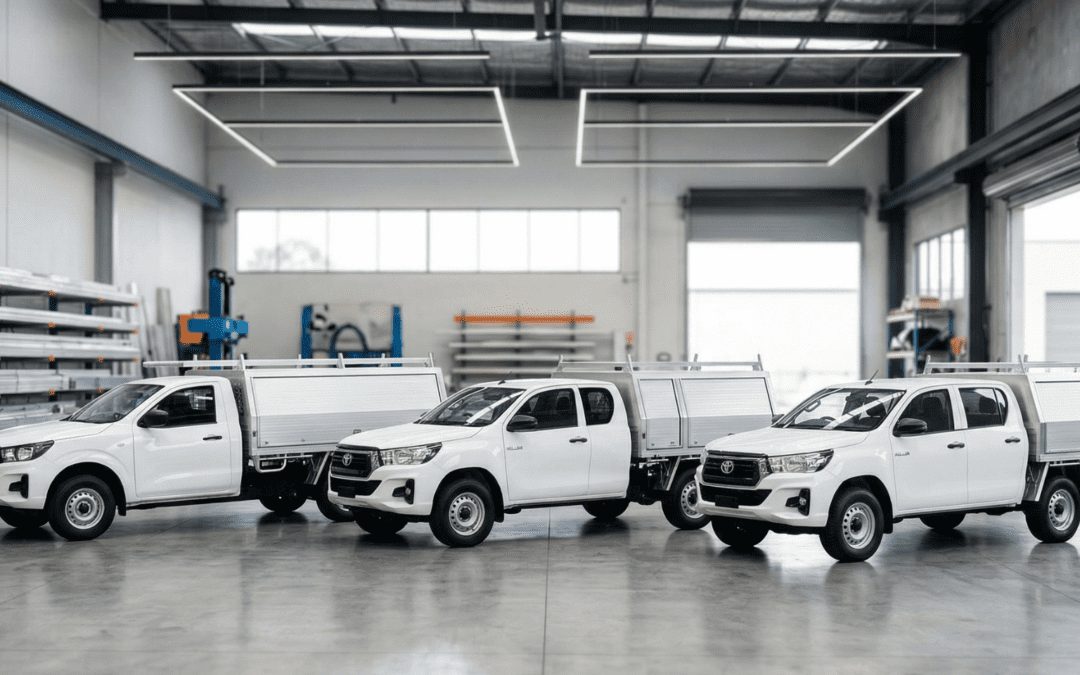
Choosing the right cab type for your fleet is one of those decisions that affects every day of the vehicle’s working life. The cab layout determines how much body length you get behind the cabin, how many people can ride in the vehicle, and how much payload is left for tools and materials.
Get it right and your crew has space for everything they need. Get it wrong and you spend years working around a compromise that costs time and money on every job.
This is a practical comparison of single cab, extra cab, and dual cab layouts for trade fleets running custom service bodies in Sydney.
Single Cab: Maximum Body Length, Minimum Cab Space
A single cab ute has one row of seats and the longest available tray or body space of any cab type. On a Toyota Hilux or Ford Ranger, the single cab gives you roughly 300 to 400 mm more body length than the dual cab version on the same wheelbase.
That extra length translates directly into more storage. For trades that carry long items (pipes, conduit, timber, ladders), a single cab service body can fit compartments and racks that simply will not fit on a shorter dual cab body.
The trade-off is obvious: only two seats. That means one driver, no passengers (or one at most). For a solo operator or a two-person crew, this is fine. For any job that needs three or more people in the vehicle, a single cab is not an option.
Single cabs also tend to have a lower kerb weight, which means more payload capacity for the same GVM rating. If you are running vehicles near their weight limit, the single cab gives you the most room to work with.
Best for: Solo operators, two-person crews, trades carrying long or bulky items, vehicles that prioritise payload over passenger space.
Extra Cab (Space Cab / Freestyle): The Compromise
An extra cab sits between the single and dual cab. It has a slightly longer cabin with small rear seats or a storage area behind the front seats, but the rear doors are smaller and the back seat space is tight.
The body length on an extra cab is shorter than a single cab but longer than a dual cab. On most ute platforms, the difference is around 150 to 200 mm compared to the dual cab.
The rear area of an extra cab is often more useful as secure in-cabin storage than as actual passenger seating. Many fleet operators remove the rear seats entirely and use the space for laptops, personal bags, high-value tools, or items that need to stay dry and locked inside the cabin.
For a two-person crew that occasionally needs to carry a third person (an apprentice, a supervisor, a client), the extra cab works. But nobody wants to sit in the back of one for a long drive.
Best for: Two-person crews with occasional need for a third seat, operators who want the in-cabin storage space without going to a full dual cab, trades that need slightly more body length than a dual cab allows.
Dual Cab: Crew Comfort, Shorter Body
A dual cab ute has four full-size doors and seating for five. It is the most popular layout in Australia for good reason: most trades run crews of two to four, and the dual cab carries them all in comfort.
The cost is body length. A dual cab service body is the shortest of the three options, and that lost length comes directly out of compartment depth and storage volume. On a Ford Ranger, the difference between a single cab body and a dual cab body can be 350 mm or more. That is an entire compartment row gone.
Dual cabs also have the highest kerb weight of the three layouts, which means the least available payload. When you fit a service body, add a roof rack, and load it with tools, a dual cab service body on a 3,200 kg GVM ute can get tight very quickly.
But there is no getting around the fact that most Sydney trade operations need to move crews. Sending two single cab utes to a job that one dual cab could cover costs more in fuel, tolls, parking, and vehicle maintenance.
Best for: Crews of three or more, businesses where vehicle comfort and presentation matter, fleet standardisation where one cab type covers most use cases.
How Cab Choice Affects Service Body Design
The cab type does not just change how much space you have. It changes how the body needs to be designed.
On a single cab, the body builder has room for deeper side compartments, longer underbody drawers, and taller rear storage. There is more flexibility for custom layouts because the tray area is larger.
On a dual cab, every millimetre counts. Compartment layouts need to be tighter, shelving needs to be more efficient, and the body builder has to work harder to fit the same amount of storage into a shorter footprint. This is where design experience matters: a well-designed dual cab body can still carry a full trade setup if the internal layout is optimised for the specific tools and equipment your crew uses.
The extra cab falls in between, and its body design often borrows the best ideas from both formats.
At Pacific Bodyworks, every build starts with the cab type and the trade requirements, not a one-size-fits-all template. A plumbing contractor’s service body needs a different layout to an electrician’s, and a single cab build uses that extra length differently to a dual cab build.
Fleet Standardisation: One Cab Type or a Mix?
For fleet operators managing multiple vehicles, there is a constant tension between standardisation and flexibility.
Running one cab type across the entire fleet simplifies everything. Training is easier because every vehicle has the same layout. Parts and accessories are interchangeable. Replacement bodies can be pre-ordered to a standard spec. And your crew knows where every tool lives in every vehicle, which saves time on site.
But forcing every role into the same cab type creates inefficiencies. A supervisor who drives solo does not need a dual cab. A cable jointing crew that needs to carry four people and heavy reels cannot work from a single cab.
The practical answer for most fleets is a mix: dual cabs for crew transport roles, single or extra cabs for specialist or solo roles. The key is making sure the service body spec for each cab type is designed as a system, with consistent branding, shared accessory standards, and compatible shelving layouts across the range.
The Cost Question: Does Cab Type Change Body Price?
Generally, a single cab service body costs slightly more than a dual cab body because it is physically larger (more aluminium, more compartments, more fabrication time). But the cost difference is usually modest compared to the total vehicle cost.
The bigger cost factors are what goes inside the body: shelving systems, drawer units, locking hardware, electrical fitouts, and trade-specific modifications. These costs are driven by the trade requirements, not the cab type.
Where cab type does affect cost is in the total cost of ownership. Single cabs are lighter, use less fuel, and have more payload headroom, which means fewer compliance issues and less wear on suspension components over the vehicle’s life. Dual cabs cost more to run but carry more people, which can mean fewer vehicles in the fleet overall.
Which Layout Wins?
There is no single winner. The right cab type depends on your crew size, what you carry, how far you drive, and how many vehicles you run.
If you are a solo sparky carrying cable drums and conduit across Western Sydney, a single cab with a full-length aluminium body gives you the most storage and payload.
If you run plumbing crews of three doing maintenance across the metro area, a dual cab keeps everyone in one vehicle and reduces fleet size.
If you want the best of both worlds and your crew is usually two, an extra cab gives you more body length than a dual cab with just enough rear space for occasional passengers or secure in-cabin storage.
The decision should start with what your crew actually needs day to day, not what the dealership has on the lot.
Spec Your Next Fleet Body the Right Way
Pacific Bodyworks builds custom aluminium service bodies for single cab, extra cab, and dual cab utes across Greater Sydney. If you want help working out which layout fits your operation, contact Steve Mills on 1300 334 878 for a no-obligation conversation.