
Every ute and light truck has a weight limit. The manufacturer sets it, the law enforces it, and your insurance policy depends on it. That limit is called the Gross Vehicle Mass (GVM), and it covers everything: the vehicle itself, the body, the driver, fuel, tools, and materials.
The heavier your service body, the less room you have for the gear that actually earns you money.
Most fleet managers and owner-operators know this in theory. But very few have sat down and calculated exactly how much usable payload their current body is eating up. When you run the numbers, the results can be uncomfortable.
How GVM Works (and Why It Matters More Than You Think)
Every ute sold in Australia has a GVM rating stamped on the compliance plate. This is the maximum the vehicle is allowed to weigh when fully loaded.
To find your available payload, you subtract the kerb weight of the vehicle (the ute with no body, no passengers, and a full tank of fuel) from the GVM. What is left is your total payload allowance, and it has to cover the service body, the driver, any passengers, and every tool, fitting, pipe, cable, or material on board.
Here is where the problem starts. A steel service body for a dual cab ute can weigh anywhere from 350 to 500 kg depending on size, compartment layout, and accessories. Some heavy-duty steel bodies with full underbody drawers and roof racks push past 550 kg.
That is a huge chunk of your GVM gone before a single tool goes in the truck.
The Payload Penalty on Popular Utes
Let’s look at some of the most common utes running service bodies in Sydney.
A Toyota Hilux SR5 dual cab has a GVM of around 3,200 kg and a kerb weight of roughly 2,070 kg. That gives you about 1,130 kg of total payload. Fit a steel service body at 450 kg, add the driver at 80 kg, and you are left with 600 kg for tools and materials.
A Ford Ranger XLT dual cab sits in a similar range, with a GVM around 3,200 kg and a kerb weight of about 2,180 kg. After a steel body and driver, your usable payload drops to around 500 to 550 kg.
An Isuzu D-Max single cab has a better payload starting point because of its lighter kerb weight and higher GVM options. But even here, a heavy steel body cuts deeply into the available capacity.
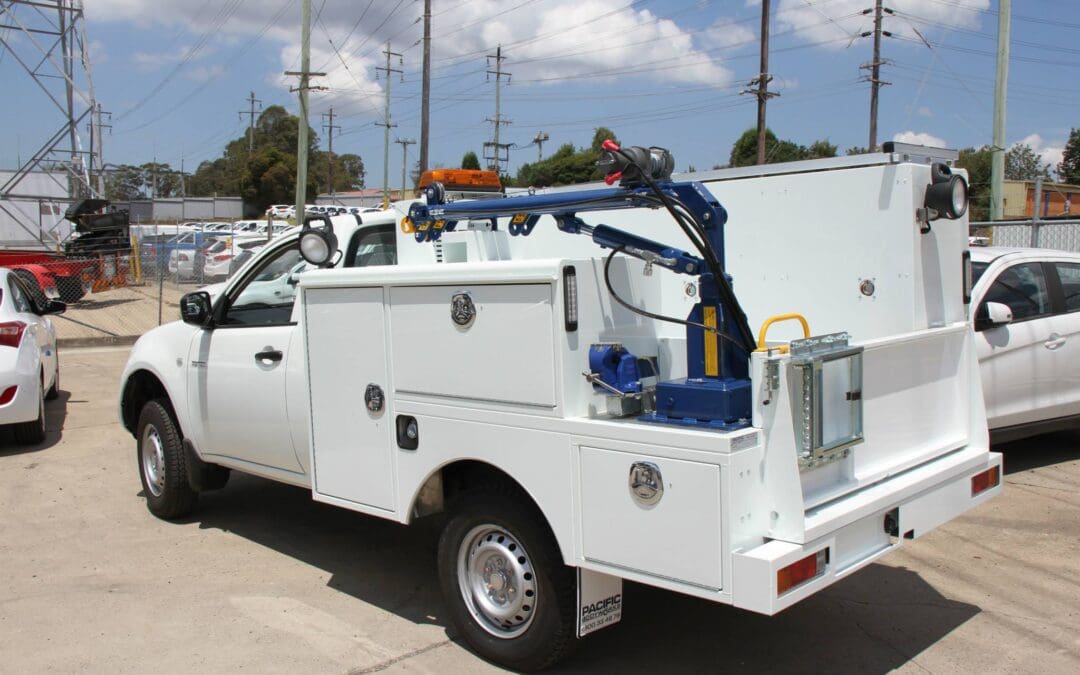
Now swap that steel body for an aluminium one. A comparable aluminium service body typically weighs 30 per cent less. On a dual cab ute, that could free up 100 to 150 kg of additional payload, which is the equivalent of an extra toolbox, a second cable drum, or a small compressor.
Why Overloading Is a Bigger Risk Than Most People Realise
Running over your GVM is not just a technical breach. It has real consequences.
If you are pulled over at a roadside inspection and your vehicle is overloaded, the driver can be fined and the vehicle can be grounded on the spot. In New South Wales, overloading penalties apply to both the driver and the operator, and they scale with the percentage over the limit.
Insurance is the bigger risk. If your vehicle is involved in an accident while overloaded, your insurer can deny the claim entirely. That means you are personally liable for vehicle damage, third party property, and any injury costs. For a fleet operator, one denied claim on one overloaded vehicle can cost more than every service body in the fleet combined.
And there is the safety factor. Overloaded vehicles brake slower, handle worse, and put more stress on suspension, tyres, and steering components. Every extra kilogram past the GVM makes the vehicle less predictable in an emergency.
The Hidden Weight: Accessories That Add Up
The body itself is only the starting point. Most trade service bodies get fitted with accessories that each add weight:
Roof racks and ladder racks can add 20 to 40 kg. Underbody trundle drawers add 30 to 60 kg per drawer. Internal shelving and racking systems add 15 to 40 kg per compartment. Bull bars, tow bars, and additional lighting add another 20 to 50 kg. A water tank, even a small one, adds the weight of the tank plus the water.
By the time a service body is fully kitted out with shelving, drawers, and roof storage, the total installed weight can be 30 to 40 per cent more than the base body alone. If you started with a 450 kg steel body, you could easily be looking at 600 kg or more once all the accessories are fitted.
That leaves almost nothing for the actual tools and materials your crew needs to do their jobs.
How to Calculate Your Real Payload Position
Here is a simple process any fleet manager can follow:
Start with your vehicle’s GVM from the compliance plate. Subtract the kerb weight (check the manufacturer spec sheet for your exact variant). Subtract the service body weight (ask your body builder for the actual weight, not an estimate). Subtract the weight of every fitted accessory. Subtract 80 kg for the driver. Subtract the weight of permanently carried items like fire extinguishers, first aid kits, and spare wheels.
What is left is your true available payload for tools and materials. If that number is under 400 kg on a trade vehicle, you are already tight. If it is under 300 kg, you are almost certainly going to exceed GVM on a normal working day.
What a Lighter Body Actually Means for Your Operation
Switching from a steel body to an aluminium one does not change how much gear your crew needs to carry. It changes how much they can carry legally and safely.
For a plumbing contractor running dual cab service bodies with jetting equipment, the weight saving from aluminium might be the only way to carry a full jetting rig without exceeding GVM.
For an electrical contractor carrying cable drums, conduit, and test equipment, an extra 100 kg of payload means one fewer trip back to the warehouse per week.
For a fleet operator managing ten or fifteen vehicles, lighter bodies mean fewer compliance headaches, lower fuel bills, and less wear on suspension and brakes across every vehicle.
The Payload Conversation Most Body Builders Skip
Here is something worth knowing. Not every body builder will have a detailed conversation about payload with you before they start building. Some will quote you a body based on what you ask for without ever checking whether the finished product will leave enough payload for your actual use case.
A good body builder will ask what vehicle you are fitting, what trade you are in, what you carry every day, and what GVM headroom you need. Then they will work backward from those numbers to design a body that fits within your limits.
At Pacific Bodyworks, payload is part of every build conversation because there is no point fitting a body that puts your vehicles over the limit on day one. Over 35 years of experience building custom aluminium service bodies in Sydney means the engineering is designed around real-world weight targets, not just what looks good in a brochure.
Run the Numbers Before You Commit
If you are speccing new service bodies for your fleet, or replacing bodies that are reaching end of life, the single most valuable thing you can do is calculate your true payload position before you choose a body.
Get the actual weights. Add up every accessory. Be honest about what your crew carries. Then compare what a steel body leaves you versus what an aluminium body leaves you.
The difference might change your decision entirely.
Talk to Us About Payload
Pacific Bodyworks builds lightweight aluminium service bodies for trades and fleets across Greater Sydney. If you want to run the payload numbers for your specific vehicles, contact Steve Mills on 1300 334 878 and we will work through it with you.